Germany Raised Its Online Slot Stake Limit for the First Time
 Aaron Mitchell
Germany raised its maximum online slot stake for the first time since the country's regulated market opened. Germany replaced the flat €1-per-spin cap with a tiered structure reaching €1, €3, or €5 depending on a player's age and recent gambling history. The legal basis for Germany's move sits in the Fourth Interstate Treaty on Gambling (Glücksspielstaatsvertrag, GlüSt V 2021). This marks the first time the Joint Gambling Authority (Gemeinsame Glücksspielbehörde der Länder, GGL) has used those powers to touch slot stakes since the market opened in 2021.
The tiered system took effect July 1, 2026. The tiered system lets operators offer €3 per spin to players 21 and over, and €5 to players 21 and over with no problem-gambling indicators over a rolling 90-day window. The default for players under 21 stays at €1. The GGL frames the change around supporting the GlüSt V's aim of "maintaining a high level of player protection," while industry coverage from NEXT.io reads the real intent as competing more effectively against unlicensed offshore operators.
What the New Tiered System Actually Requires
The tiered structure replaces a single flat cap that had applied since the market's launch in July 2021. The tiered structure sets three thresholds by age and recent gambling behavior.
- €1 per spin for players under 21
- €3 per spin for players 21 and over
- €5 per spin for players 21 and over with no problem-gambling signs across a rolling 90-day period
The path to that top tier runs through continuous behavioral tracking, not a one-time age check.
Operators must verify each player's status through Germany's LUGAS (Länderübergreifendes Glücksspielaufsichtssystem) monitoring system before offering €3 or €5 stakes. Operators must also cross-check the OASIS self-exclusion register at the same time, according to reporting from iGaming Business. The verification duty does not end once a higher limit is granted. Operators must intervene, by contacting, restricting, or suspending an account, if warning signs appear later.
Entain's Simon Priglinger-Simader, who also serves as vice president of the Deutscher Online Casinoverband (DOCV), called the change "a positive signal for the regulated gambling market." That reaction is shared across the operators the DOCV represents.
The number worth watching here isn't €5, it's 90 days. Age-based limits are simple to audit from the outside; a rolling behavioral window isn't. Whether this actually moves channelization comes down to how well LUGAS holds up under real player volume, not the size of the new ceiling.


Why Now: The Channelization Fight Behind the Decision
Channelization, the share of German gambling activity happening on licensed sites rather than offshore ones, sits at the center of this decision. Channelization is also the most contested number in German gambling policy, with estimates ranging from official confidence to open dispute. The gap between those estimates explains the pressure the GGL was under to act.
The channelization figure the GGL prefers is 77.03%, based on a commissioned study surveying 2,000 online gamblers. The channelization figure the DOCV prefers sits under half, citing sampling and recall-bias problems in the GGL's methodology. That gap widens further for slots specifically. The DOCV puts slot channelization at just 20% to 40%. An October 2024 ruling from the Hessian Tax Court, cited in primary research from the Handelsblatt Research Institute, concluded the slot-specific black market share is likely above 80%.
The unlicensed market's direction is not in dispute, whatever the exact channelization figure. The unlicensed market generated an estimated €547 million in revenue in 2024, up 17% from €466 million the year before, according to the GGL. Session-level losses tell a similar story. Unlicensed-site players lost about €89 on average per session, compared with €77 on licensed sites, evidence the black market is pulling in higher-value players rather than casual ones.
A 30-plus point gap between the GGL's own channelization estimate and the industry's competing figure isn't a rounding error; it's a sign neither side has a number solid enough to build policy on with confidence. The honest reading is that Germany raised stakes based on the direction of the black-market trend, not a verified size of the problem.
Germany's Online Slot Market by the Numbers
Germany's online slot market generated €543 million in Gross Gaming Revenue (GGR) in 2025. Germany's online slot market grew 11% from €490 million in 2024, on total stakes of €4.6 billion. The scale of that market sits inside a much larger regulated gambling sector. Germany's total regulated gambling sector generated €14.4 billion in GGR for 2025, flat against the prior year. Land-based casinos still account for roughly three-quarters of that total. The unusual tax structure behind the online numbers is why operators welcomed a stake increase in the first place.
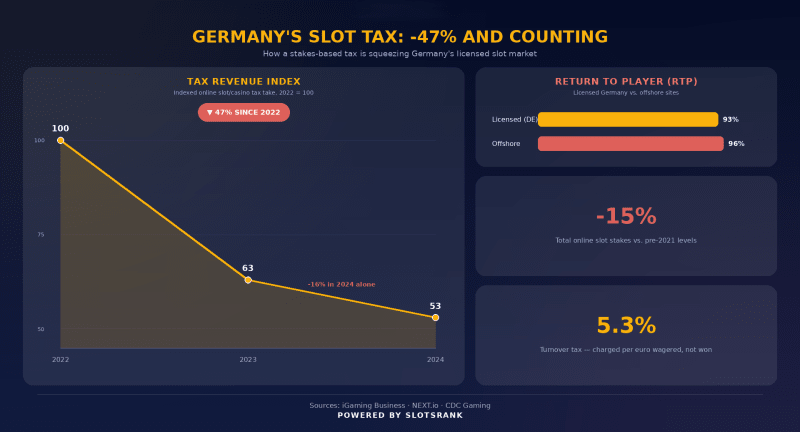
The turnover tax on German online slots applies at 5.3% of every euro wagered, not of profit. The turnover tax eats into margin heavily enough to push licensed German slots down to roughly 92% to 94% Return to Player (RTP). That margin squeeze compares starkly with the roughly 96% RTP available on unregulated offshore sites. Online casino and slot tax revenue fell 16% in 2024 alone, a cumulative 47% decline since 2022. Total stakes now sit 15% below pre-2021 levels. DOCV President Dirk Quermann has argued turnover-based taxation is the wrong model for slot products entirely.
This is the part the official framing doesn't say plainly: a turnover tax built to fund player protection is the same policy compressing RTP low enough to make the unlicensed market's 96% look attractive. Raising the stake ceiling treats the symptom of competitiveness without touching the tax model that's arguably pushing players offshore in the first place.
How Germany's New Ceiling Compares Across Europe
Germany's new €5 ceiling lands in the middle of Europe's range of stake limits, not at either extreme. Germany's new ceiling is also conditional and tiered, unlike most of the countries it now sits alongside. The conditional design behind that ceiling is what actually sets Germany apart from its neighbors. Five other markets show how wide that range runs.
- United Kingdom: £5 per spin for adults 25 and over, £2 per spin for players 18 to 24, both introduced in 2025.
- Ireland: €10 per spin, roughly double Germany's new top tier.
- Greece: €20 per spin, raised from a €2 cap, the most permissive limit among Germany's neighbors.
- Netherlands, Sweden, and Spain: no per-spin stake limit, relying instead on deposit caps and centralized self-exclusion registers such as Cruks and Spelpaus.
Even at €5, Germany's ceiling remains among the more restrictive limits on the continent, roughly on par with the UK's top rate of £5 (about €5.80). That ceiling is reachable only after 90 days of clean behavioral monitoring, though, not a simple age check.
What actually separates Germany from the UK isn't the ceiling, it's the gate. The UK draws its line by age; Germany is betting that continuous behavior monitoring is a better filter than age or geography. If LUGAS's infrastructure doesn't hold up at scale, this could end up the hardest stake limit in Europe to actually audit.
What the Behavioral Screening Is Meant to Catch
Gambling disorder affects roughly 2.2% of German adults aged 18 to 70, according to the Glücksspiel-Survey 2025. Gambling disorder shows the strongest link to online slots of any gambling product the survey tested. That link is sharpest among young adults. Players aged 18 to 25 carry a disorder rate roughly double the general adult population's. The survey behind these figures covers 12,340 people, led by the Institute for Interdisciplinary Addiction and Drug Research at the University of Bremen. That age gap is exactly why the GGL attached a 90-day screening window to its highest stake tier rather than opening it to every adult immediately.
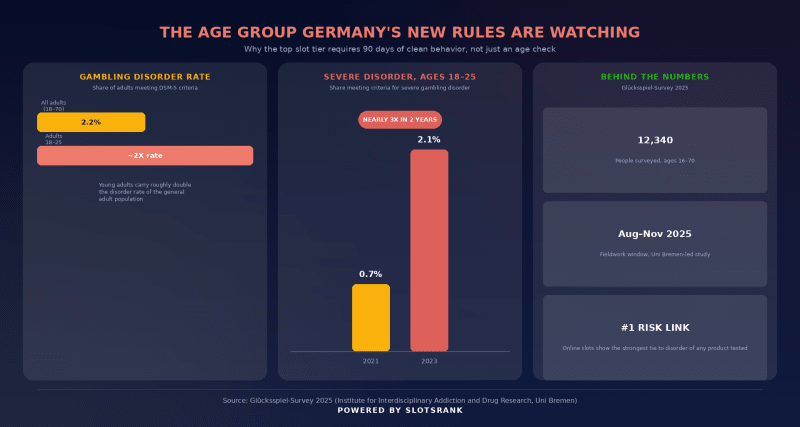
Severe disorder among 18-to-25-year-olds nearly tripled between 2021 and 2023, rising from 0.7% to 2.1%. Severe disorder at that pace is what pushed the survey's authors to recommend structural prevention over individual self-control. That recommendation sits uneasily next to a policy change built around a higher spending ceiling. The Fachverband Glücksspielsucht, Germany's national addiction-treatment association, continues to argue for a smaller, more tightly advertised market instead of a more permissive one. The 90-day monitoring requirement is the GGL's attempt to reconcile those warnings with an industry asking for more room to compete.
We'd flag the sequencing. A rolling 90-day window is a lagging safeguard by design. It only catches a problem after it's already shown up in someone's play. Pairing that exact mechanism with the age group whose severe-disorder rate just tripled is a reasonable compromise, but it's a compromise, not a fix.
What Happens Next
Germany's stake increase lands just months before a bigger decision. Germany's stake increase is widely read, by regulators and industry alike, as a preview of the first statutory review of the 2021 Interstate Treaty, due to finish by the end of 2026 and go before the Bundestag. The outcome of that review matters more than this one change.
Deposit-limit guidance expires at the end of 2026. Deposit-limit policy is where industry groups want the next fight. The target of that fight is the blanket €1,000 monthly cap, which industry groups want replaced with limits tied to income and credit checks. The worst-case outcome, in Priglinger-Simader's own words, is a return to a flat €1,000 ceiling. The next quarterly GGL slot data for the second half of 2026 settles whether the increase improves channelization or only sharpens operators' marketing argument.